Is Tile Flooring Right for Your Home? A Massachusetts Contractor's Honest Take
Is tile flooring a good choice for Massachusetts homes?
Tile flooring is an excellent choice for bathrooms, kitchens, entryways, and mudrooms in Massachusetts homes when the subfloor is properly prepared before installation. Porcelain tile in particular handles moisture, temperature swings, and heavy foot traffic better than most flooring materials available at a comparable price point. The one condition that determines whether tile is right for a specific room is the subfloor. A floor that flexes underfoot needs reinforcement before tile can be installed correctly. In older Massachusetts homes, this preparation step is common and adds to the upfront cost but is what makes the floor last.
The Short Answer and Why It Depends on One Thing
Tile flooring is one of the most durable, lowest-maintenance, and longest-lasting flooring options available for Massachusetts homes. In bathrooms, kitchens, mudrooms, and entryways it consistently outperforms the alternatives over a 10 to 20-year period. But whether tile is the right choice for your specific floor in your specific home depends almost entirely on one factor: the condition of the subfloor beneath it.
Tile is rigid. Subfloors flex. When there is too much movement in the subfloor relative to what the tile and grout can tolerate, the floor fails. Tiles crack. Grout breaks apart. The installation that looked great on day one starts showing problems within a few years. This is not a tile problem. It is a preparation problem.
In central Massachusetts, where a significant share of homes were built between 1940 and 1985, subfloor conditions vary widely. Some are perfectly ready for tile. Others need reinforcement first. Knowing the difference before you commit to a flooring material is the most important step in any flooring project, and it is something we assess on every job we take before we give a homeowner a number.
This post covers when tile is the right call, when it is not, how it compares to the main alternatives, and what the process looks like for homes in Lunenburg, Fitchburg, Leominster, and the surrounding communities.
Where Tile Flooring Performs Best in Massachusetts Homes
Bathrooms
Bathrooms are where tile flooring has the clearest advantage over every other option. Daily moisture exposure, temperature changes from steam and ventilation, and the foot traffic pattern of a frequently used room all favor a hard, dense, water-resistant surface. Porcelain tile absorbs less than half a percent of water by weight. Ceramic tile absorbs slightly more but still performs well in a bathroom with proper installation.
Luxury vinyl plank is the main competitor for bathroom floors right now and it does handle moisture reasonably well. But it sits on top of the subfloor rather than being bonded to it, which means it can lift at the edges over time in rooms that see consistent moisture. It also has a surface layer that wears down with heavy use, eventually exposing the core material beneath. Tile does not have this limitation. A properly installed tile floor in a bathroom will look and perform the same in year 15 as it did in year one.
Kitchens
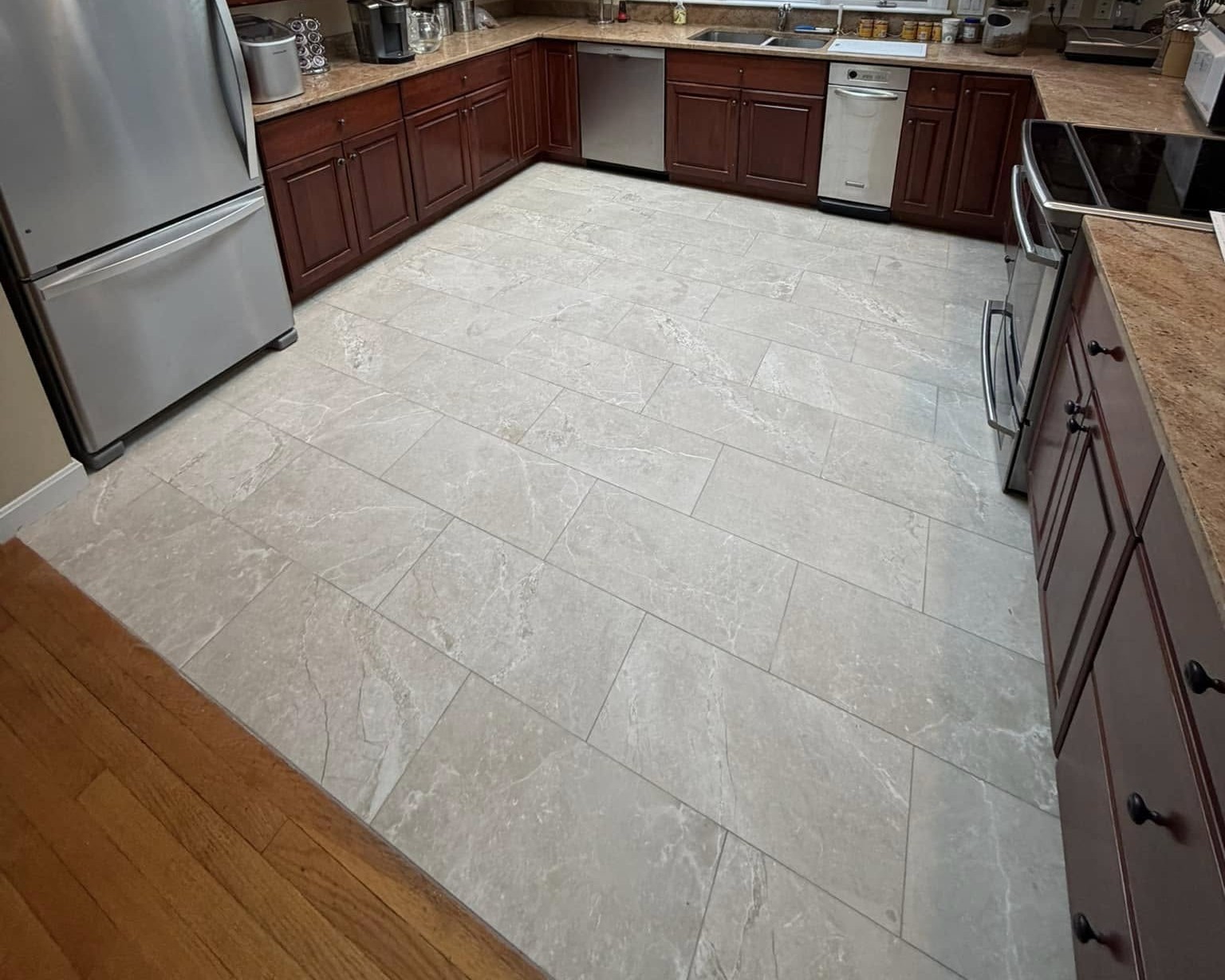
Kitchen floors take heavy use. Dropped dishes, grease, standing water around the sink and dishwasher, and constant foot traffic are the daily reality. Tile handles all of it without special maintenance or concern. A porcelain tile kitchen floor can be cleaned with a wet mop, handles spills without absorbing them, and does not scuff, dent, or scratch from normal kitchen activity.
The main tradeoff in kitchens is comfort underfoot. Tile is hard, and standing on it for extended periods can be tiring. A kitchen mat at the main work areas addresses this for most homeowners. For anyone with significant joint problems, this tradeoff is worth considering before committing to tile across a large kitchen floor.
Large format porcelain in a 24x24 or 24x48 format is the most popular kitchen floor tile in central Massachusetts right now. Fewer grout joints means less cleaning and a cleaner, more open look in a busy room.
Entryways and Mudrooms
Entryways and mudrooms in Massachusetts homes take seasonal abuse. Salt, sand, snow melt, mud from spring thaw, and wet boots all concentrate in these spaces. Tile is the most practical flooring choice for both areas because it handles all of it without special care. It can be wet mopped, does not absorb road salt or grime, and does not mat or compress the way carpet does over time.
Mudrooms in particular benefit from smaller format tile that creates a more textured, grip-friendly surface underfoot when floors are wet from incoming foot traffic. A 12x12 or 12x24 matte-finish porcelain is a common and practical choice.
Basement Floors
Basement floors are where tile makes sense under specific conditions. If the concrete slab is level, dry, and stable, tile can be installed directly over it with appropriate primers and setting materials. If the basement has a history of moisture intrusion, tile over the slab is not a good idea. Moisture coming up through concrete pushes tile off the slab over time and creates conditions for mold beneath the tile surface that can be difficult to address without full removal.
We evaluate basement floors on a case-by-case basis. In dry, conditioned basements in central Massachusetts homes, tile is a solid choice. In basements with moisture history, other options are worth considering first.
Where Tile Is Not the Right Answer
Living Rooms and Bedrooms
Tile in living rooms and bedrooms is technically possible but uncommon in central Massachusetts for good reason. These spaces benefit from warmth and softness underfoot in a way that kitchens and bathrooms do not. Hardwood, engineered wood, and luxury vinyl plank all deliver a more comfortable surface for a room where people walk barefoot, sit on the floor, and spend extended time.
That said, some homeowners do tile living rooms and dining areas in larger open-concept spaces, particularly when the same tile runs through from the kitchen to create a consistent look. If this is a direction you are considering, the subfloor preparation requirements are the same as in any other room and need to be addressed first.
Rooms with Significant Subfloor Problems
If a subfloor has extensive rot, multiple soft spots, or structural issues beyond normal reinforcement, tile may not be the right call until the underlying problem is fixed. In cases where the subfloor needs significant structural repair, the repair cost may change the budget calculation for the whole project. We always assess the subfloor honestly during the estimate and let homeowners know what they are working with before they commit to a material.
Tile vs. Luxury Vinyl Plank: The Honest Comparison for Massachusetts Homes
Luxury vinyl plank has become very popular over the past five years and the marketing around it is aggressive. It is not a bad product, but it is not the right product for every room, and the claims made about it are sometimes overstated. Here is an honest comparison for homeowners in central Massachusetts.
Durability and Lifespan
A properly installed tile floor will outlast a luxury vinyl plank floor in almost every scenario. High-quality luxury vinyl plank with a thick wear layer will hold up well for 10 to 15 years under normal use. A tile floor installed over a properly prepared subfloor with quality setting materials and grout will hold up for 25 to 40 years or longer with basic maintenance.
In rooms that take heavy use, like primary bathrooms, kitchens in busy households, and entryways, tile's durability advantage is meaningful. In lower-traffic rooms, luxury vinyl plank's shorter lifespan may be less of a concern.
Moisture Resistance
Both tile and luxury vinyl plank handle surface moisture well. The difference is in what happens if moisture gets beneath the floor. Tile bonded to a properly prepared subfloor with the correct setting materials does not allow moisture to migrate beneath it under normal conditions. Luxury vinyl plank, because it floats or is glued rather than fully bonded, can allow moisture to collect beneath the planks if there is any source of water getting under the floor. This is most commonly an issue in bathrooms and basements.
Comfort and Sound
Luxury vinyl plank wins on comfort and sound. It has a softer feel underfoot, more warmth, and absorbs impact sound better than tile. In bedrooms, living rooms, and upper-floor spaces where sound transmission matters, these characteristics are real advantages. In bathrooms and kitchens, where the moisture and durability considerations favor tile, the comfort difference matters less because people are not typically standing on those floors for extended periods.
Cost
Luxury vinyl plank is generally less expensive than tile for the material itself. Quality luxury vinyl plank runs $3 to $7 per square foot. Porcelain tile runs $3 to $15 per square foot depending on format and quality. Installation costs are similar between the two materials for standard rooms. Where tile adds cost is in subfloor preparation, which is more critical for tile than for floating luxury vinyl plank floors.
For rooms where both materials are appropriate, the upfront cost difference often narrows or disappears when you factor in the longer lifespan of tile. For rooms where tile is clearly the right technical choice, the cost comparison is less relevant because the alternative is not really equivalent.
Repairability
This one goes to luxury vinyl plank. If a plank is damaged, it can often be replaced individually without disturbing the rest of the floor. If a tile cracks and the original tile is discontinued or a dye lot match is unavailable, replacing a single tile without it standing out is more difficult. Keeping a few extra tiles from the original installation is a practice we recommend to every homeowner who installs tile, specifically for this reason.
The Subfloor Question: What Older Massachusetts Homes Require
This section is specific to the housing stock in Lunenburg, Fitchburg, Leominster, Harvard, Groton, and the surrounding communities. It does not apply the same way to newer construction.
Homes built before approximately 1990 in central Massachusetts were framed for the flooring products that were common at the time. Hardwood, linoleum, and carpet. These products tolerate subfloor flex that tile cannot. The standard subfloor assembly in a home from this era is often thinner, has more movement, and may have decades of additional flooring layers stacked on top of the original decking.
Before tile can be installed in one of these homes, we check for deflection. The test is simple: walk the floor and feel for bounce or movement. A floor that moves noticeably underfoot is not ready for tile without reinforcement. A floor that feels solid and firm typically needs only normal preparation.
When reinforcement is needed, the most common approaches are installing cement backer board over the existing subfloor, adding a layer of plywood to stiffen the assembly, or in cases where the existing flooring stack is already too high, removing the old flooring entirely before adding the appropriate underlayment.
This preparation adds cost to a tile flooring project. In a typical bathroom in an older central Massachusetts home, subfloor preparation might add $300 to $800 to the total depending on what the floor needs. We build this into the estimate based on the site assessment so there are no surprises once the old floor comes up.
Skipping this step to save money is the most common reason tile floors fail in older homes. The movement that was in the subfloor before the tile went down is still there after the tile goes down, and eventually the tile or grout gives first.
How Much Does Tile Flooring Cost in Massachusetts?
Tile flooring costs in central Massachusetts depend on the room size, the tile selected, and the subfloor preparation required. Here is a realistic range based on projects we complete regularly in this market.
Standard Bathroom Floor: $1,200 to $2,800
A standard bathroom floor in a typical 50 to 80 square foot bathroom runs between $1,200 and $2,800 depending on tile selection and subfloor conditions. Porcelain tile in a 12x24 format at the mid-range price point, with standard subfloor preparation, lands in the middle of this range for most bathrooms we work in.
Kitchen Floor: $2,500 to $5,500
Kitchen floors cover more square footage and often involve more complex layouts around islands, cabinets, and appliances. Most kitchen tile flooring projects in central Massachusetts run between $2,500 and $5,500 depending on size, tile format, and subfloor preparation required.
Entryway or Mudroom Floor: $800 to $2,000
Smaller rooms with straightforward layouts run at the lower end of this range. Entryways and mudrooms with more complex tile patterns or significant subfloor work run higher.
Large Format Tile Premium
Large format tile in a 24x48 or larger format adds cost to any floor installation. These tiles require more precise subfloor leveling, different setting materials, and more careful handling during installation. If large format tile is part of the plan, budget at the higher end of the ranges above.
What to Ask Before You Commit to Tile Flooring
Before you choose a tile and hire a contractor, these are the questions worth having answered.
Will you assess my subfloor before giving me a final price? Any contractor who quotes a tile floor job without visiting the space and checking the subfloor is giving you a number that may not reflect the real cost of the project. Subfloor conditions in older homes are not predictable from a photo or a phone call.
What subfloor preparation is included in the estimate? Ask this specifically. Know whether the preparation cost is in the quote or whether it will be determined after the old floor comes up. The two approaches lead to very different experiences mid-project.
What tile format are you recommending and why? A contractor who recommends large format tile for a bathroom floor without discussing the slope requirements and installation complexity either has not done this many times or is not thinking about your specific floor. Ask why they are recommending what they are recommending.
How long will the project take and when can I use the floor? A tile floor needs time to cure before foot traffic. Ask specifically when the floor will be ready to walk on and how many days the room will be out of service. For a kitchen or bathroom, this matters for planning.
At Grams Tile, we answer all of these questions during the free estimate. We visit the space, check the subfloor, assess the conditions, and give you a clear scope and price before any commitment is made. We work in Lunenburg, Fitchburg, Leominster, Acton, Groton, and across north-central Massachusetts. Call (978) 382-0639 or request an estimate on our website.
Frequently Asked Questions: Tile Flooring in Massachusetts
How do I know if my subfloor can support tile?
Walk the floor and pay attention to any bounce, flex, or movement underfoot. A floor that moves noticeably is not ready for tile without reinforcement. A firm, solid floor is typically ready for normal tile preparation. If you are not sure, a contractor can check deflection with a straightedge and assess whether additional work is needed. We do this at every estimate at no charge.
Is porcelain tile better than ceramic for floors?
For most floor applications in Massachusetts homes, porcelain is the better choice. It is denser, absorbs less water, and holds up to daily use better than ceramic over a long period. The material cost difference between porcelain and ceramic is relatively small for most standard formats. For a detailed comparison of the two materials, our post on porcelain vs ceramic tile covers the differences in depth.
Can tile be installed over existing tile flooring?
In some cases, yes. If the existing tile is fully bonded to the subfloor, the surface is level, and the added height does not create a transition problem at doorways, tiling over existing tile is possible. In older Massachusetts homes where the existing tile may be poorly bonded or where the subfloor beneath it has issues, removing the old tile and starting fresh is usually the better long-term call. We assess this during the estimate.
How long does tile flooring last?
A properly installed tile floor will last 25 to 40 years or longer with basic maintenance. The grout is typically the first component to show age. Resealing grout every few years and recaulking movement joints at transitions extends the life of the floor significantly. The tile itself, when correctly installed over a properly prepared subfloor, rarely fails from normal use.
Does Grams Tile install tile floors in Fitchburg and Leominster?
Yes. Grams Tile installs tile floors throughout north-central Massachusetts including Lunenburg, Fitchburg, Leominster, Acton, Groton, Littleton, Harvard, Hudson, Lancaster, and Ayer. We provide free in-home estimates and include a subfloor assessment with every flooring project. Call (978) 382-0639 to schedule yours.
